Bathroom Break – flash fiction in PowderBurn Flash

My second publication for the year – Bathroom Break – is now up at PowderBurnFlash.

Feeling a little bored with having seen yet another movie where the kidnapper lets the victim go to the bathroom and she escapes through the window, I wondered if there was a way to write around that cliche and still have a satisfying, entertaining story, without that “groan” factor. I hope I’ve succeeded. Let me know what you think.

Dieselpunk – print anthology – call for submissions

I’m editing an anthology of Dieselpunk for Static Movement. See the Dieselpunk thread on the Static Movement boards for full submission guidelines. Steampunk’s bastard cousin, Dieselpunk looks for speculative fiction filled with rugged, chunky engines but no sign of electronics. What would the would be like if we still had those huge 1950s aircraft, locos and cars, but no computers?

This is a non-paying anthology – for the love only.

The best of 2010

December 31st, 2010

I’ve published a lot of stories this year, as you can see from my bibliography. They’re all, for one reason or another, personal favourites, though some I might have thought a little less of have proven more engaging for some readers. I’ve tried a variety of styles and genres this year, from hard sci-fi to humourous horror and been published both in print and online.

Anyway, this selection is my favourite five online stories from the year:

Fledgling (The New Flesh)

Sunset Photographer (365Tomorrows)

Jacob’s Naked Aquarium (Bewildering Stories – selected for best of quarterly review, 3rd quarter 2010)

Zemogorgon (Pulp Metal Magazine)

Zombie-Eyed Girl (Flashes in The Dark)

___________________________________

Overall, it’s been a good year, a banner year in fact – I’ve published more this year than all previous years combined – exceeding my own ridiculous goal (lesson: aim high). I still have so much more to work on and a set of new goals that will push me and challenge me – I will publish far fewer pieces, but look for longer stories, and different approaches.

See you in 2011.

Fibonacci poems to end the year

The Fibonacci Review publishes regular issues of Fibonacci poetry. The site explains it better than I can, but the poems – Fibs – are based on the Fibonacci sequence – lines with increasing numbers of syllables: 1, 1, 2, 3, 5, 8, and variations of that.

Three of my poems appear in the December issue – French Nocture and, together, Bar, and Musicpoemusic. Fibs are fun, if challenging to write – check out some of the other poems in the issue to, some of these poets are way cleverer with the form than I am.

Zombie Love for Morons in The New Flesh

Well, it’s Christmas here, but my special Christmas Eve story “Zombie Love for Morons” should be appearing in The New Flesh right about now.

I’ve always thought those “for dummies”, and so on, series had a kind of built-in problem, but they seem very popular (our library has around 150 titles – thinks like “Rugby Union for dummies” [well, duh], Golf Rules and Etiquette for dummies”, “SQL for dummies” [I mean, how many dummies are computer programmers?]). Zombie Love seemed like a good topic to parody that – but how to do it without getting too boring? Flash fiction, of course. How to write it as flash – ah, well, that’s the approach: have a read.

Happy Christmas, all.

Last Night in Twisted River by John Irving

I’ve been following John Irving’s work for many years now – most people would know him as the author of The World According to Garp or A Prayer for Owen Meaney or perhaps for winning the Oscar for best adapted screenplay for The Cider House Rules (adapted from his own book). I even wrote part of my thesis about his work.

Irving takes his time over new books – three, four, five, six years – so a new one is a treat. Last Night in Twisted River came out last year in hardback, but only recently in paperback. Told with Irving’s usual wry eye and laconic humour, it’s the story of a father and son on the run over several decades. While plot is perhaps very central to the book, for me it’s Irving’s style – his pacing, his deft use of language, his ability to write less than linearly yet still build the book cohesively. My one quibble is the number of typos – as if someone hasn’t even proofread the OCR file before publishing: things like “betwcen” or “Afer” (for “After”) – not a lot, but enough to bump me from the story for a second. Filled with moments of tragedy and moments of laugh out loud humour, this is a book to savour.

Ganglion Trains – new sci-fi at The Fringe Magazine

This is another odd piece – not set in any previous universe, but perhaps in something I’d like to explore more. What if there was an analogue transport network, linked like the synapses in the brain, and spanning the globe, making transport quicker the way jet planes altered the way we travel? Ganglion Trains is my little caper story where I begin having fun in this concept.

Thanks to Scott at The Fringe for taking this story, quirky as it is.

Nancy Pickard – The Scent of Rain and Lightning

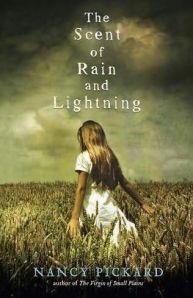
Well, it’s not an Arizona novel, but Kansas feels near enough – certainly in terms of ranching and wide open landscapes, so for me that’s a big part of the appeal of Nancy Pickard‘s novel. Similar to Ray Robinson’s Forgetting Zoë, which I reviewed a few posts back – note even the similarity of the covers (though this is the UK cover – the edition I read – the US cover is slightly different).

And as with Robinson’s book The Scent of Rain and Lightning involves a crime, and the solving of that crime. Structurally the book is unusual, and challenging – opening in the present time, with the memory of the murder and some sudden changes coming from that – then dropping back to a time shortly before the original crime, in what it would appear to be a quick flashback that gradually becomes the main part of the novel.

With rising tension – we know the crime is coming – Pickard expertly delays and delays, delving into the family and their situation, making the murder almost inevitable. When, far into the novel, we’re returned to the present time, those sudden changes – the release of murderer from jail – take on a whole new context, and give the story a whole different, though inevitable direction. The ending is unexpected, the story-telling tight and fast, the atmosphere evocative.

This book is perhaps more in the realm of crime writing than Robinson’s, though both bear similarities. It is an engaging, tight read, and I’ll be looking for more of Pickard’s books.